
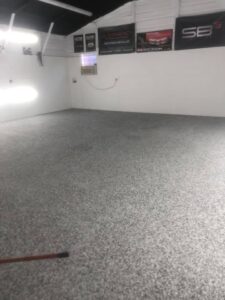

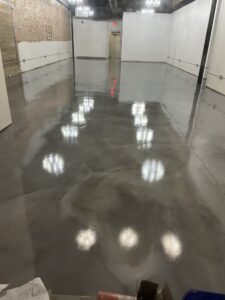

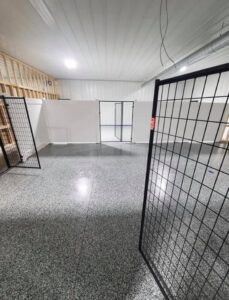

Every metallic epoxy floor sold in Houston is sold from a photograph. Usually a nine square foot sample shot from twelve inches away under a ring light, with saturation pushed. Then the floor goes down across nine hundred square feet under recessed cans and the client stands in the doorway wondering why it does not look like the picture.
It is not that the installer got it wrong. It is that a metallic epoxy floor is a fluid art surface, and fluid art does not scale, repeat or photograph honestly. This is what the finish genuinely looks like in a real room, why it varies, and what to insist on before anyone mixes resin.
How the effect is actually created
The base is a high build, usually a hundred percent solids epoxy, tinted to a base color. Suspended in it are metallic pigments, fine mica or similar platelets coated to reflect light directionally. Those platelets are the whole trick. They orient themselves as the resin moves, and where they line up you get shimmer, where they collide you get depth.
The installer pours the tinted base, then introduces one or more accent colors, then moves the resin. Squeegees, rollers, chip brushes, leaf blowers and directed air all get used. Alcohol or a solvent applied to the wet surface breaks the film locally and opens cells, which is what produces the ring and crater patterns people recognize as metallic.
Then it stops moving and cures, and whatever it was doing at that moment is permanent. There is no undo. A clear topcoat goes on top to protect the artwork and set the gloss level.
Why no two floors match
The variables are temperature, humidity, film thickness, the exact timing of every manipulation, how much air the installer used and where, and the flatness of the slab underneath. Change any one and the pattern changes. Two rooms in the same house, poured by the same crew on the same day, will read as siblings and not as twins.
Accept that up front and metallic is a wonderful floor. Expect a repeated pattern and you will be unhappy no matter who installs it.
What it actually looks like in a room
Three things surprise clients the first time.
The first is scale. On a small sample the cells and veins read as intricate detail. Across a large floor those same features read as broad movement, like polished stone or weathered metal, and the fine detail disappears at standing height. Bigger rooms need bolder color contrast to read at all, and a sample that looks perfect at arm’s length can look muddy across a showroom.
The second is light. Metallic pigment is directional, so the floor changes as you walk across it and as the light source moves. Under a bank of downlights you get bright pools and dark bands. Under diffuse daylight from a north window you get a much flatter, calmer surface. The same floor genuinely looks like two different products at nine in the morning and nine at night, and that is the feature, not a defect.
The third is gloss. A full gloss metallic is a mirror. It doubles every light fixture, shows every footprint, and reveals every deviation in the slab underneath as a visible wave. That last part is the one that costs money to fix after the fact, which is why substrate flatness is a metallic decision and not a general prep decision. Where the slab is out of plane, it gets corrected before the artwork goes down, not after.
Gloss, satin, and the honest trade
Full gloss maximizes depth and reflection and is the reason people want metallic in the first place. It also maximizes maintenance. Dust is visible within a day, footprints show, and fine scratches accumulate into a haze in traffic lanes over a few years.
A satin topcoat cuts the depth by a noticeable amount and cuts the maintenance burden by more. In a busy salon, a restaurant or a retail floor, satin is usually the correct professional recommendation even though gloss is what wins the sale. Ask to see both on the sample, in your room, with your lights on.
Where it belongs in a Houston building
Interior commercial space is the natural home. Showrooms, salons, med spas, tasting rooms, boutique retail and lobbies all benefit from a floor that does visual work. Residential wise, it lands in home bars, entryways, garages built as display space and the occasional living area.
Two Houston specific constraints apply. Direct sun is the first: standard epoxy ambers under ultraviolet exposure, so any metallic floor with unshaded south or west glass needs a UV stable aliphatic urethane topcoat, and that needs to be written into the quote. The second is the slab itself. A gloss film over a slab with vapor coming through it blisters, and on a mirror finish a blister is not subtle. That makes moisture testing before installation non optional on this system rather than merely advisable.
Where metallic is the wrong tool, say so early. A wash down kitchen, a wet process plant or a floor that will see thermal shock wants urethane cement flooring instead. A warehouse aisle wants a hard wearing solid color. A garage that will see dropped tools and jack stands is often better served by a flake build, which hides damage instead of highlighting it.
What to ask before you sign
Ask for a sample made on a board at least two feet square, by the crew doing your floor, with your color set. Small chips do not communicate movement. Ask to see the sample laid on your slab, in your room, at two different times of day.
Ask what the plan is for slab flatness and what the grinding and patching scope includes. Ask whether the topcoat is aliphatic urethane or clear epoxy, and get the answer in writing if the room has significant glass. Ask what the gloss level will be and whether satin is available in the same system.
Ask what happens if you do not like the result. On fluid art the honest answer is that a floor can be recoated and reworked, and it is a real cost in time and material, so the sample stage is where disagreement should happen. Any contractor who promises the floor will match a photograph is telling you what you want to hear.
Our metallic epoxy floor service covers sampling on site before scheduling, because on this system the sample is the specification. If you are still weighing metallic against other decorative directions, our post on decorative epoxy floors for homes and businesses lays out the range, and choosing the right concrete floor finish works through the selection logic.
For lifespan expectations across resin systems generally, see how long epoxy flooring lasts in Houston. We install metallic floors across the metro including The Woodlands. Call (832) 521-4347 or use the instant quote form to get a sample scheduled.
Frequently asked questions
Can a metallic epoxy floor be made to match a photo?
No. The pattern is created by fluid movement during a short working window, and temperature, humidity, film thickness and the installer’s hand all change it. A good crew can match a color family, a level of contrast and a general character. Nobody can reproduce a specific image, and anyone who says otherwise is overselling.
Does a metallic epoxy floor show scratches?
A gloss finish shows fine scratching over time, particularly in traffic lanes and near entry doors where grit gets tracked in. A satin topcoat hides it substantially better. Walk off matting at entries is the single most effective thing you can do to slow it down, because almost all scratching comes from grit underfoot.
Is metallic epoxy suitable for a garage?
It can be, and it looks striking in a display garage. Two cautions. The gloss reveals every low spot in the slab, so flatness correction may be needed first, and dropped tools chip a gloss film in a way that is visible. If the garage is a working space rather than a showpiece, a flake build hides wear far better.
How long before you can walk on and drive on a metallic floor?
Typically light foot traffic somewhere around a day after the final coat, and vehicle traffic several days later, but the numbers belong to the specific product and the ambient conditions. High humidity and low temperature both extend cure. Get the actual windows from the installer for the actual system and plan the move back in around them.
Will a metallic floor fade or yellow near windows?
Standard epoxy ambers under ultraviolet light, which shifts the color. A UV stable aliphatic urethane topcoat prevents it. In a Houston room with unshaded west facing glass this is the difference between a floor that still looks right in five years and one that has gone visibly warm along the sun line.